The Alchemy of the Third
On the rare grace of being invited into a couple's evening — and what a gay man learns when he is welcomed into a kind of presence he never expected to know.
I am a gay man. The first sentence of this essay needs to be that one, because everything that follows would be misread without it. My life is built around men — the texture of male attention, the way a male hand asks a different question than a female one, the long quiet of a Sunday morning beside the kind of person I have always loved. None of that is a phase, none of it is a pose. It is the floor under everything.
And yet. Once or twice a season, a couple writes to me. They are usually long-married or long-paired. He is a man who watches; she is a woman who has decided, often after years of careful conversation, that she would like to be looked at by a person who was chosen for her by them both. They are not looking for a performance. They are looking for a third presence — discreet, gentle, attentive — who can hold the room while they discover something about themselves. That a gay escort would be their first instinct surprised me, the first time. I think I understand it better now.
Why a gay companion, of all people
The honest answer is that I am not, in the older sense of the word, available to her. Not because I am unkind, not because I am cold, but because the entire architecture of my desire points elsewhere. This sounds, written down, as if it would make me a poor choice. In practice, it makes me a very particular kind of safe choice. He does not have to manage a rival; she does not have to manage a seducer; the room is not contaminated by the small political weather of a man pursuing a woman he has just met. What is left, when those weathers are absent, is something I did not know existed: a presence that can be tender without claiming, attentive without conquering, close without taking.
I do not think I would have understood this at twenty. I understand it now because the couples who write are usually patient teachers. They tell me, in the careful first messages, what they are and what they are not. He explains that he has spent years learning to watch his wife with the attention she deserves and only sometimes receives. She explains that there is a kind of being-looked-at that she has been curious about — slow, without project, without a script — and that they have decided to seek it together rather than separately. I write back, in the same register, and we plan the evening at the speed of people who know that haste would ruin it.
What I have learned about feminine presence
This is the section I have written and rewritten, because there is a version of it that is true and a version that is opportunist, and the line between them is thinner than I would like. Let me try the true one.
A gay man is, in the rooms he usually inhabits, never asked to read the slow forms of feminine pleasure. He learns about them, if he learns at all, from cinema, from his mother's silences, from the long descriptions his straight friends never quite manage to articulate. He is, in a way, illiterate in a language that organises half the world. To be invited into a couple's evening as the third presence is to be given, by people who have nothing to gain from teaching me, a quiet lesson in that literacy. I do not become a different man for the evening. I become a more attentive one.
What I have learned is that feminine pleasure, at least in the rooms I have entered, is far less about gesture than I had imagined and far more about pace. The hand that pauses two centimetres above the shoulder for a beat longer than it needs to. The eye that holds, releases, and returns. The conversation that does not insist. There is, in the women I have met in these evenings, an extraordinary patience with being arrived at slowly. I had been raised on the male grammar of arrival, where speed is sometimes mistaken for sincerity. The feminine grammar I have been let into is the opposite: sincerity is what survives the deceleration.
I will not pretend this rearranged my desire. It did not. I left these evenings as gay as I arrived. What it rearranged was something quieter — my understanding of what attention can be, when it is not bent toward conquest. I take that home with me. The men I love benefit from it too.
The choreography of three
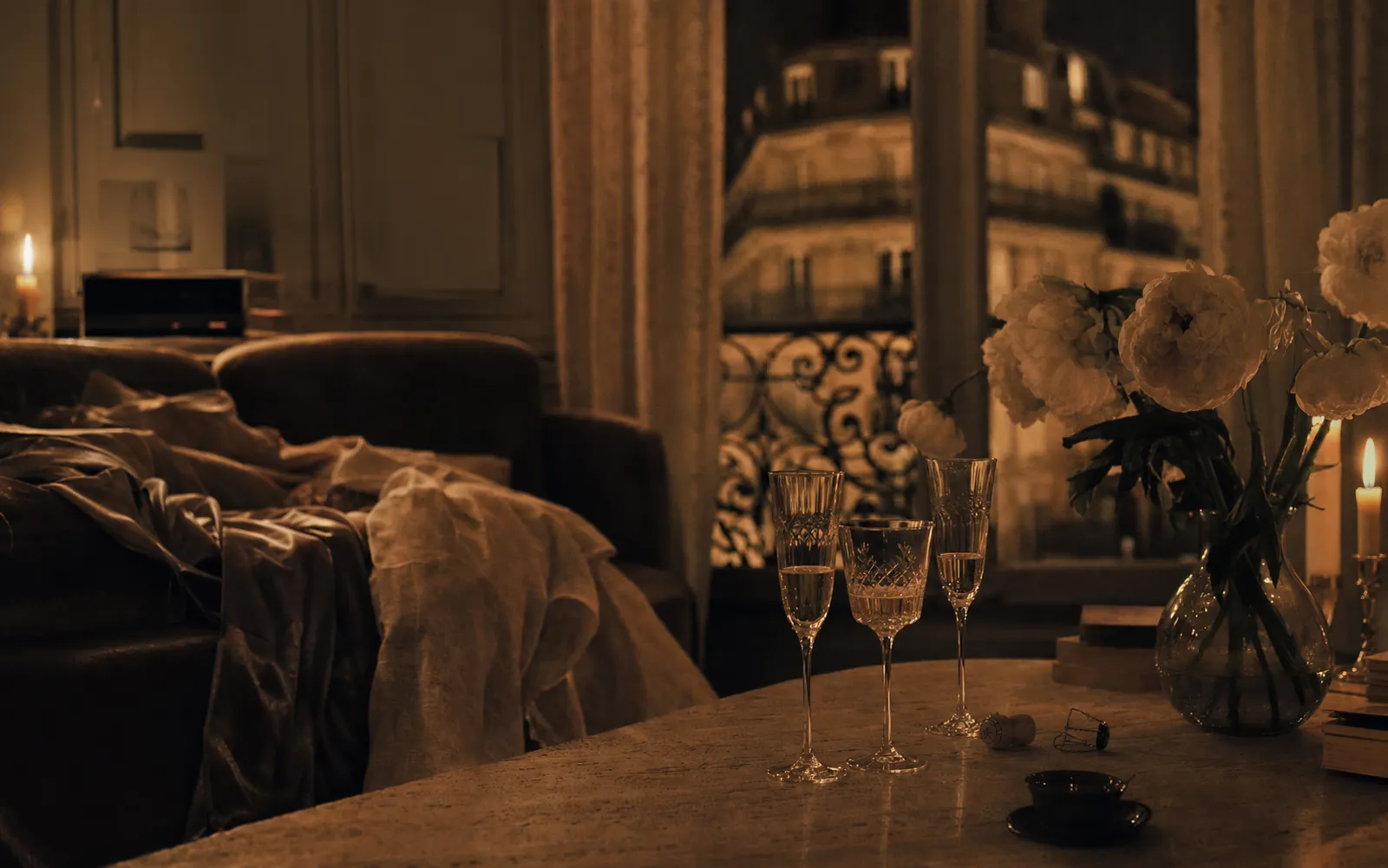
A couples evening, in practice, is not a sexual mathematics problem. It is a slow piece of chamber music for three instruments, two of which already know each other very well. My role is to listen first, to ask second, and to move only when both of them are ready for the next bar. The first hour is almost always spent at a table, with a single bottle of something good — usually a Champagne they chose, occasionally a wine he wanted me to taste. There is no script. We talk about Paris, about the weeks behind us, about a film one of us has seen. I learn the names they use for each other when there is no audience.
I have noticed that the moment of transition — from the living room to wherever the evening continues — almost never comes from me. It is theirs to make, and they make it when they have decided, between themselves, that they are ready. I have been in evenings where that moment never came, where we stayed at the table for four hours and went home as people who had simply met. Those evenings are not failures. They are, often, the ones the couple remembers most fondly: the night they decided they did not need to do anything, only to discover that they could have.
When the moment does come, the choreography stays slow. I follow her cues more than his — he has already learned to read her, and the privilege he is sharing with me is precisely that reading. My job is to offer a second pair of hands and a second pair of eyes, never a competing intelligence. If she wants to be held while he watches, I hold. If she wants to be watched while he holds her, I watch. If they want me to disappear for fifteen minutes into the kitchen and come back, I disappear. The evening belongs to the couple. I am the temporary acoustics of their room.
What the husband actually gives
I want to say something about the men in these couples, because they are the figures the world is least curious about and the ones I have learned the most from. The husband, in a well-handled couples evening, is doing something quietly heroic. He is allowing his wife to be seen with the slow attention he himself gives her every day, and he is allowing that attention to be given by a man whose desire will never compete with his. This is a generosity of a kind I had not, before these evenings, known to be possible.
The men who arrange these nights well are almost always patient watchers. They are not directors. They do not stage. They sit in a particular chair, or they stand near a particular window, and they let the evening happen. What they want, I have come to think, is not so much to see their wife with another body as to see her at the speed at which the rest of life rarely lets her be seen. They are giving her the gift of being slowed down. The third presence — me, in these cases — is the instrument through which the slowing happens.
The morning after
I have never stayed the night with a couple. The agreement is almost always that I leave when the evening ends — late, but not too late — so that they can wake up beside each other in a room that is theirs again. This is, I have come to feel, the most important rule of the form. The third presence is a guest, not a tenant. The bed is theirs.
The messages the next morning are some of the most touching I have ever received in this work. They tend to be short. They tend to be written by both of them, or by one with the other named in the first line. They tend to thank me for what I did not do as much as for what I did. A couple wrote, last summer, simply: We needed to remember how to slow down with each other. You helped us do that without being in the way. Thank you. That sentence has stayed with me longer than most.
A note on what this is not
I should say, since the question always sits in the room: I am not bi-curious. I am not in the process of discovering that I have always been something else. I am a gay man who, every once in a while, is invited by a couple I trust into an evening that asks me to be more attentive than my ordinary life requires. The gift is not in any rearrangement of my desire. The gift is in the rearrangement of my attention — in being asked, by two people who love each other carefully, to be present in a register I would not otherwise meet.
I would not do this often. Three or four times a year, at most, with couples whose first messages already tell me they know how to handle the form. I would not do this as a service in the brutal sense. I do it as a slow piece of work, when the people are right and the room is right and the evening can hold it.
If you are a couple reading this and you have been considering, for some time, whether such an evening might be for you — write. Not to book. To talk. The first conversation is always long, and it is always free. We will know, by the end of it, whether the alchemy is possible.
Jules Sauvage is a high class independent gay escort based in Paris, available for refined encounters with men and, occasionally, with couples — by appointment only. To begin the conversation, please write via the booking page.