The Sunday Morning Threshold
On the quiet shift that only the second day makes possible.
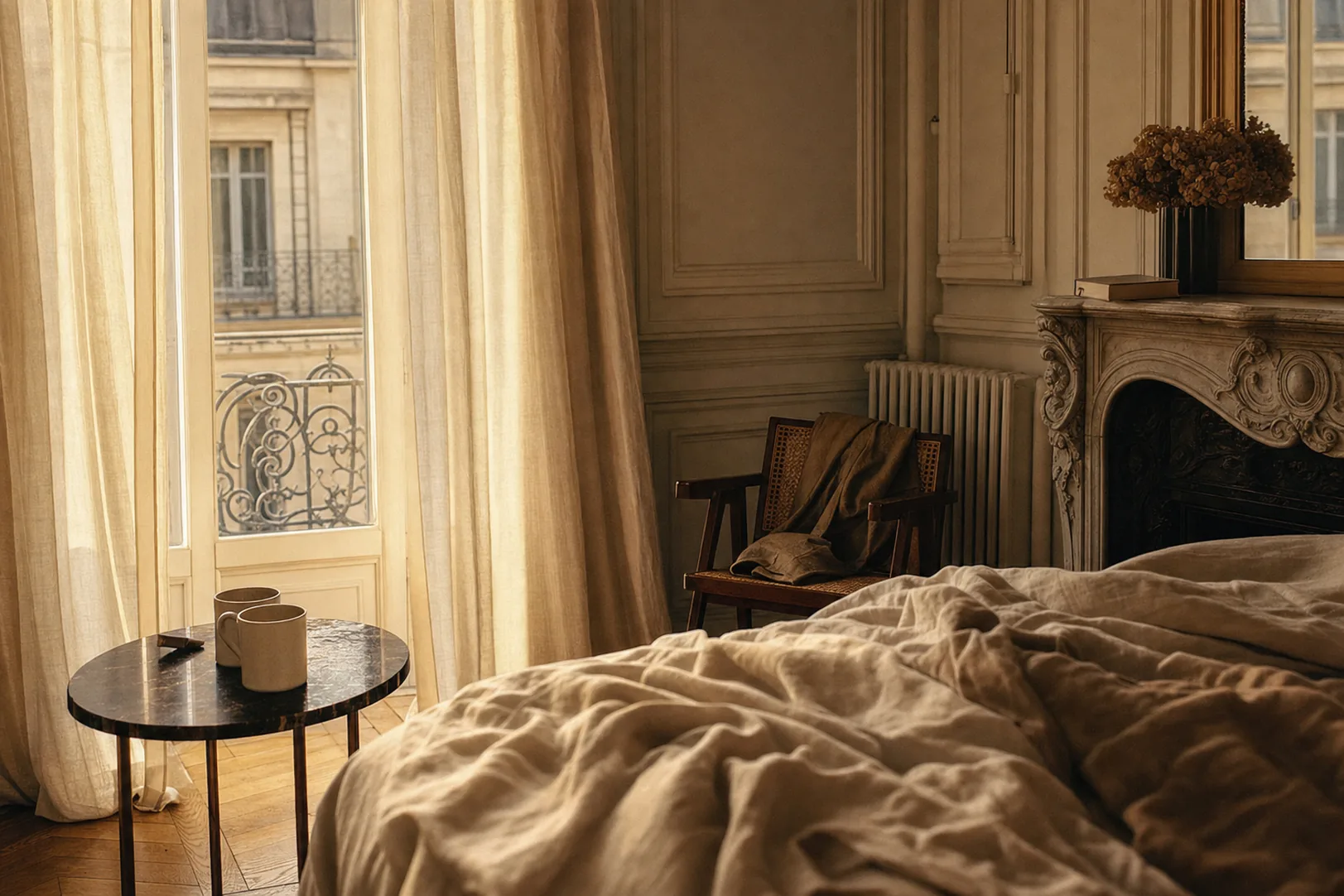
There is an hour on Sunday morning — not a precise hour, more a quality of light — when I understand that something has happened that I had not planned for. Nothing dramatic. Nothing in the room has changed. The curtains are the same; the city behind the glass is the same. But the man beside me breathes differently than he did thirty-six hours ago, and so do I.
That moment is what the weekend exists to produce. Not Friday evening's arrival — though the arrival is something in itself, carrying its own mix of promise and faint nerves. Not even Saturday, which has its own moods. It is the Sunday morning, and what you find there when you have given yourself enough time to arrive.
Friday evening: the art of not rushing
The first evening is delicate. There is always, in the opening hours, a kind of courtesy that both people extend to each other — attention that is slightly performed, a wanting to do things right. I know this feeling from where I stand: the desire to be present enough, to read correctly, to miss nothing. And I recognise it from the other side too, in the way a man sits slightly too straight at the beginning of dinner and then, almost imperceptibly, releases somewhere around dessert.
What I have learned not to do on Friday evening: accelerate. Attempt to compress the stages, to manufacture intimacy by effort. It never works, and it shows. Intimacy is not something you perform — it is something you let arrive, by building the conditions in which it can. A good Friday evening closes without having said everything. We eat, we talk, we laugh at moments we did not anticipate. And then we sleep — in the same room, each with our own night.
Saturday: when the world recedes
By Saturday morning, something has shifted. Not overturned — shifted, the way a piece of furniture turned slightly reveals a window you had not noticed. The morning coffee is the first moment without protocol. Neither person is playing a role yet. It is too early for that.
Saturday belongs to both of us — to neither of us. It is the day that makes itself up.
I have come to prefer Saturdays with no fixed programme. Not from any lack of ideas, but because an unscheduled Saturday leaves room for the questions that matter: does one feel like going out, or staying? Walking, or lingering? These small negotiations — not in words, just in glances and slight movements — are, in their own way, the most honest form of conversation. One starts to learn how the other moves through the world.
There is a moment on Saturday afternoon — usually after lunch, sometimes later — when I notice that the man across from me has put his phone face-down on the table. Not by decision. Just because he forgot to turn it back over. That gesture tells me that the outside world has receded. We are in our own duration now. I do not say this — it does not need to be said.
Saturday night: what has settled
Saturday nights have a different quality from Friday's. On Friday, one discovers. On Saturday, both people already know something about each other — not everything, never everything, but something real. Ease comes more quickly. Silence is more comfortable. One can simply be there without having to justify it.
There is also, sometimes, a soft melancholy that enters the room around midnight — an awareness that tomorrow will have an end. Not sadness, exactly. More a sharpened consciousness of what is present, precisely because it is not forever. I have learned not to chase that feeling away. It is part of what the weekend offers: the rare luxury of something that knows itself to be finite.
Sunday morning: the light of that day
And then there is Sunday. That light — paler than Saturday's, more tentative, as though the day itself is not entirely certain it wants to begin. Sunday mornings in Paris carry a suspended quality that no other hour of the week quite has.
I look at the man beside me and understand that we have crossed something together. Not an adventure — the word is too large, too romantic. More: a duration. We have shared time that resembled nothing else, because we had enough of it to make it our own.
What remains on Sunday morning is something that neither of us could have manufactured in an evening. The weekend does not promise it. It makes it structurally possible.
The coffee arrives. We talk little, or we talk about everything — it no longer matters which. The guard dropped a long time ago. What is left is two people in a room, on a Sunday morning, with a quiet awareness of what has been built and what will, soon, come to an end.
What stays, afterwards
Sunday afternoon, there is always a moment when things re-order themselves — bags, coats, the first sentences of ordinary life returning from wherever they had been kept. I do not try to extend this moment or shorten it. It has its own dignity.
What has struck me, over the years, is that the men who return after a weekend return for different reasons than those who return after an evening. After an evening, one comes back because it was good. After a weekend, one comes back because — for the length of two days — something felt possible: a way of being with someone that resembles nothing found elsewhere. And once that feeling has been had, one wants to know whether it is repeatable.
Sometimes it is. Not always. But the fact that one cannot know in advance — that, perhaps, is also why one comes back.
Jules Sauvage is a high class gay independent male escort based in Paris, available for longer formats by appointment only. To enquire, please write via the booking page.