Discretion as a Practice
What true confidentiality means in high-end companionship.
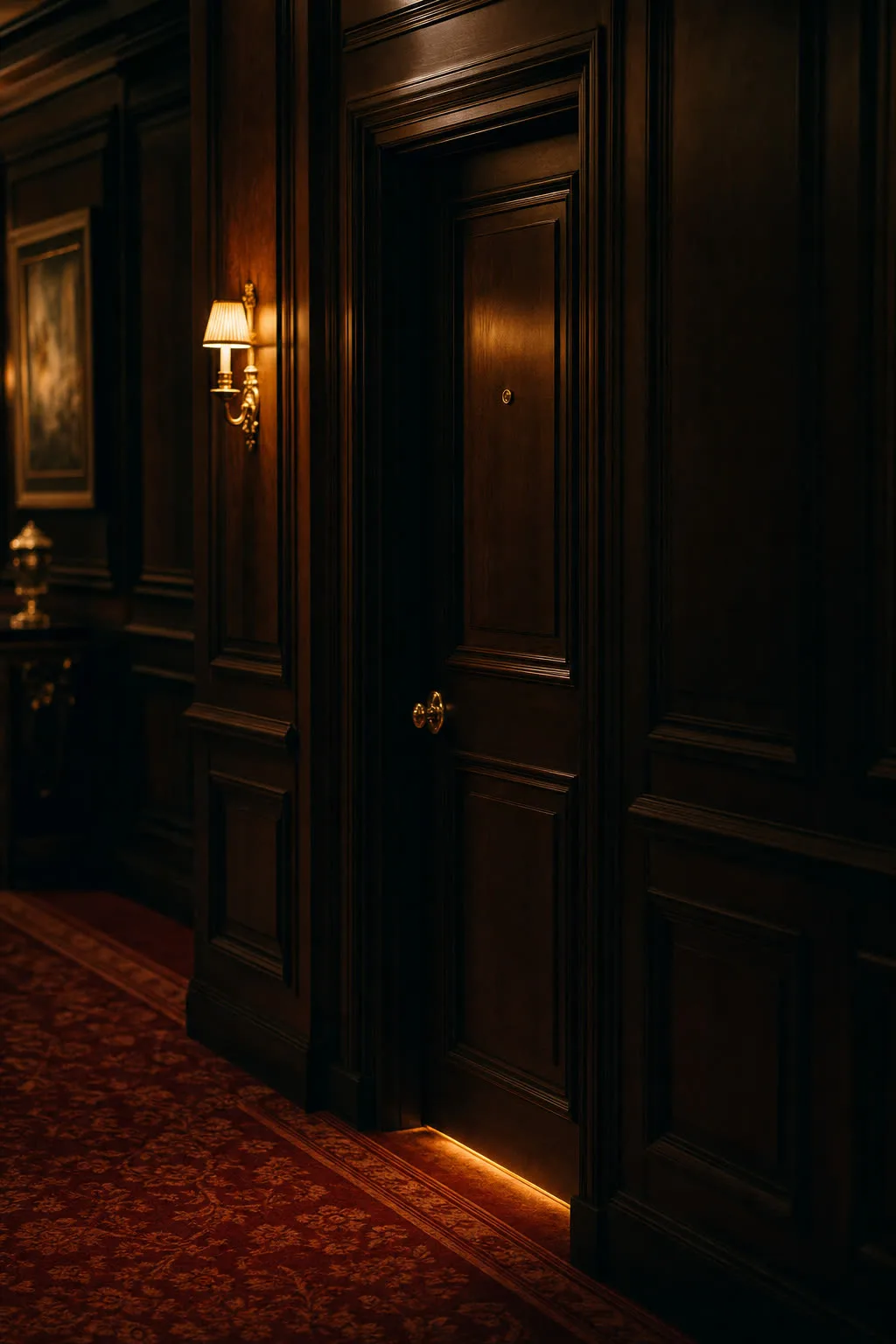
The taxi stopped on a side street, not in front of the hotel. That detail — chosen before we had even spoken a word that evening — said everything about the kind of company I aim to keep. Not the company of those who promise silence, but the company of those who understand, instinctively, that the most elegant form of protection is to leave nothing requiring protection in the first place. My host stepped out first, turned the corner, and disappeared through a service entrance. I waited two minutes, then followed through the lobby, arriving at the elevator as though I had been a guest all along. Nobody looked up. Nobody needed to.
Discretion, I have come to believe, is not a disposition. It is a practice — closer to a discipline than a personality trait, closer to architecture than to instinct. It must be designed, maintained, and occasionally tested.
Silence Is Not Discretion
There is a common confusion between the two: people imagine that the discreet man is the quiet man, the one who volunteers nothing. But silence, on its own, is only absence. It can be conspicuous. A man who refuses to speak at dinner, who looks away when a name is mentioned, who offers no colour when conversation moves near sensitive territory — that man draws attention precisely through his reticence. His silence is a signal.
Discretion operates differently. It is the art of full presence without trace — of being entirely, warmly, intelligently in a moment, and of that moment leaving no sediment in the world. The great writers of psychological interiority understood this. Madame de La Fayette, in La Princesse de Clèves, constructs a world in which the most devastating revelations are made through what characters choose not to say, not to ask, not to acknowledge. Henry James built entire novels on the architecture of the withheld — the knowledge circulating just beneath the surface of social exchange, never erupting, never quite named. Discretion, in that literary tradition, is not absence. It is the most sophisticated form of intelligence.
The distinction matters practically. Confidentiality — the legal notion, the signed undertaking — binds a person contractually. It creates an obligation, enforceable, written, witnessed. Discretion is something else entirely: it is the behavioral, aesthetic, and moral complement to that legal structure. A person can be technically confidential and behaviorally indiscreet — one thinks of the trusted employee who never divulges names but whose manner in certain rooms, or whose visible relationship with certain figures, says everything. Discretion closes those gaps. It is the practice that confidentiality cannot legislate.
The Geometry of Chosen Places
Much of discretion is spatial. It is expressed not in what one says but in where one goes, how one arrives, and which route one takes home.
As a high class gay male escort Paris-based, I have developed a quiet vocabulary of places and approaches. The hotel whose side entrance opens onto a residential street. The restaurant with a dining room separated from the bar by a full wall — not a glass partition, a wall. The car that waits one block east rather than at the door. These are not paranoid arrangements. They are simply considerate ones — the spatial equivalent of keeping one's voice low in a library.
A similar logic governs timing. Arrivals in the middle of a dinner service are unremarkable; the maître d' has other concerns. Early evening, when a hotel lobby is at its most transitional — guests checking in, staff changing shift — offers its own natural camouflage. These are not tricks. They are habits of attention, applied to the built environment.
The choice of place also communicates something to the person one accompanies: I have thought about this before we arrived. Your ease here is not accidental. I arranged it. That silent message — that prior consideration — is itself a form of intimacy. It says: I take your privacy as seriously as you do, perhaps more so, because I have had longer to think about how to protect it.
The Language of Not-Naming
If discretion has a spatial grammar, it also has a verbal one. And its most essential rule is negative: do not name what does not need to be named.
This is subtler than it sounds. The instinct in conversation, particularly in professional settings, is toward precision — toward naming interlocutors, dates, places, institutions. It creates the impression of reliability, of substance. But in certain contexts, that precision is its own exposure. The discreet companion learns to navigate between two registers: enough colour to keep conversation alive and warm, not enough specificity to constitute a record.
I do not ask, as a matter of principle, questions whose answers I have no need to hold. The name of the company. The nature of the negotiation. The reason for the trip to Paris. These are not my territories, and entering them without invitation would be a kind of trespass — not merely an indiscretion, but a failure of respect. The forum internum of another person — that private inner chamber of thoughts, intentions, and circumstances — is sovereign. My role is never to cross its threshold uninvited.
What I do ask — and what I do remember — is what is offered. The preference for a particular wine. The city someone visited as a child and still speaks of with a quality of light in their voice. The subject that makes them lean forward slightly at the table. These are the things worth holding. They are also, notably, the things that could never embarrass anyone.
There is an art, too, in what one does not appear to notice. The bespoke suit worn to dinner and then, two hours later, slightly less precisely aligned. The phone checked under the table with a movement too practiced to be casual. The name mentioned once and then deliberately not repeated. A discreet companion does not register these. Or rather: he registers everything, and makes no record. The distinction is between perception and retention. To see without cataloguing. To observe without accounting.
What Discretion Is Not
I want to be precise about this, because the failure mode exists on both sides.
Discretion is not coldness. It is not the emotional withdrawal of a person who has armored themselves against engagement. On the contrary: true discretion requires warmth, because warmth is what makes a person comfortable enough to be themselves — and it is only when someone is fully themselves that the question of privacy even arises. A companion who maintains discretion through emotional distance is protecting nothing; he is simply present without being there.
Discretion is not condescension. The impulse to protect someone's privacy can curdle, imperceptibly, into a kind of management — into treating one's companion as a figure to be handled. That is its own violation. True discretion is a gift offered freely, not a service rendered from above. It requires a genuine equality of regard, even across whatever asymmetries of circumstance might otherwise structure the encounter.
And discretion is absolutely not indifference. The discreet man remembers. He simply does not perform his memory in public. There is a profound difference between a man who has forgotten what you told him and a man who carries it quietly, brings it out only when relevant, and would sooner lose his own confidences than yours. As a discreet companion — as a discreet gay companion who works at a certain level in this city — I am the latter. What passes between us stays between us not because I am obligated to silence, but because I understand that the value of what we share is precisely its privacy.
The Trust That Cannot Be Promised
There is a paradox at the heart of discretion: it cannot be demonstrated in advance. It can only be recognised in retrospect, over time, through the accumulation of unremarkable moments — conversations that went no further, appearances that left no trace, confidences that were never discovered to have traveled.
Trust, in the end, is not built by declarations. Every person who has ever betrayed a confidence first promised to keep it. Trust is built by consistency — by the patient, unglamorous work of behaving the same way whether observed or not, whether the person concerned is present or absent, whether the stakes are high or negligible. It is built by having, and maintaining, a practice.
That is what I mean when I say that discretion is not a silence but a discipline. Silence can be broken by accident or by pressure. A discipline, once it has become habitual, becomes structural — as reliable as architecture, as unremarkable as breath. It does not require an effort of will in the moment, because the moment has already been prepared for by everything that preceded it.
The most elegant confidence is the one that, years later, neither party feels the need to acknowledge. Not because it has been forgotten, but because its safety was never in question.
Jules Sauvage is a Paris-based companion — cultivated, discreet, and at ease in the environments his guests inhabit. His work sits at the intersection of genuine encounter and considered privacy. He writes occasionally about the culture of high-end companionship: its ethics, its aesthetics, and what it asks of those who practise it with care.