The Art of the Dinner Companion
On the quiet choreography of being accompanied at Paris's finest tables.
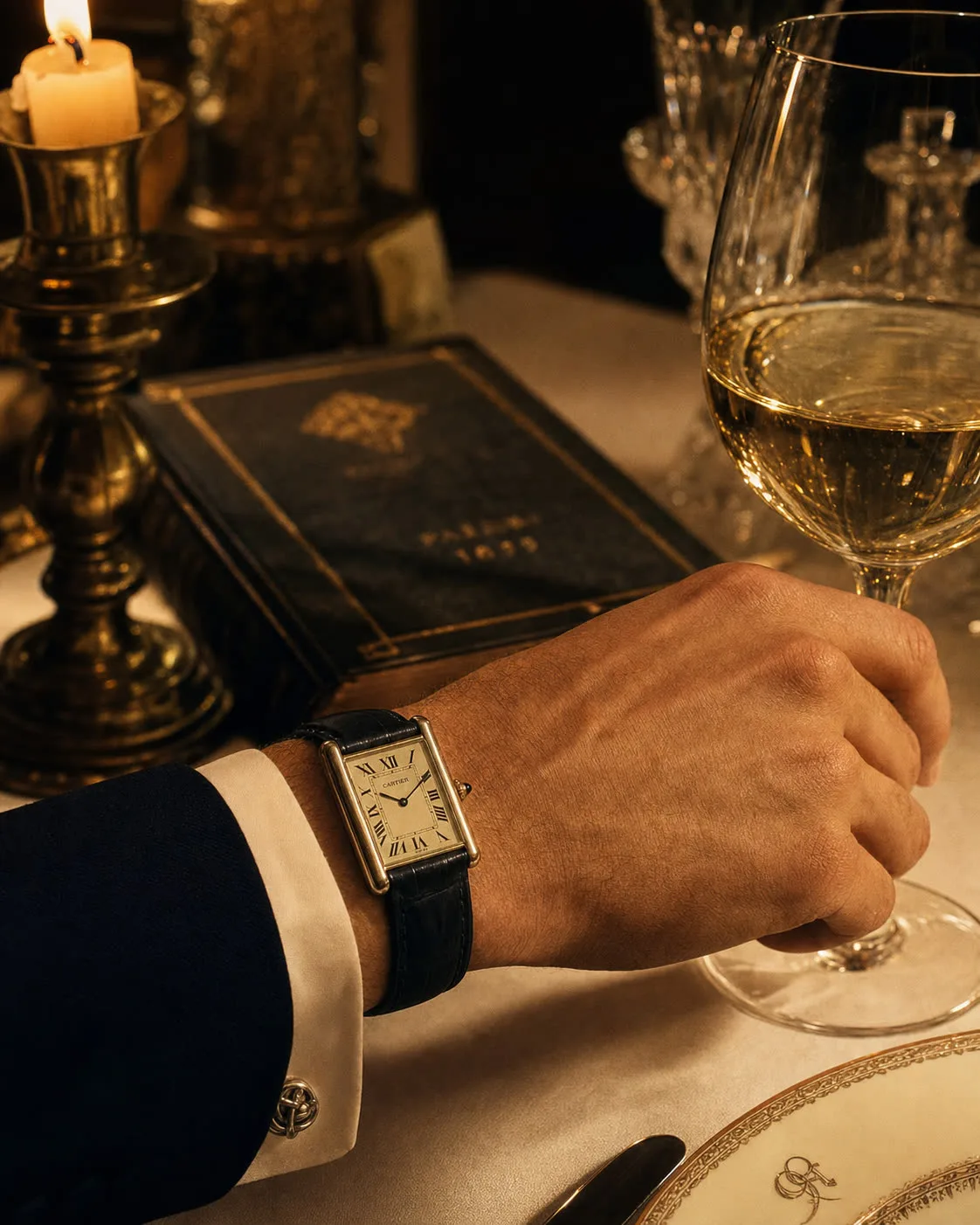
A first dinner is rarely about food. The Michelin stars on the awning, the sommelier's diction, the weight of the cutlery — these are scaffolding. What the evening is actually for, what every careful man has eventually said over a second glass of Chablis, is the rare luxury of being seen without being read. To dine with a companion is to outsource, for the length of three hours, the labour of social existence: someone who knows when to speak French to the maître d', when to laugh at the right line, when to disappear politely between courses. The art is in the choreography, not the meal.
Reading law in Paris, I have come to understand the dinner table as a kind of contract. Not the legal sort — though I have learned to read those too — but the older, unwritten variety. A reservation at Plaza Athénée or L'Ambroisie is a tacit agreement that, for the duration of the evening, two people will perform a version of intimacy that is more carefully composed than most marriages. My role, as I have come to understand it, is to make that composition feel inevitable rather than rehearsed.
The geography of Paris dinners
Paris is, for those who pay attention, a city of micro-cuisines and micro-rituals. The arrondissement matters. A Tuesday at Le Cinq in the 8th is not the same evening as a Friday at Septime in the 11th — even if the meals cost similar sums. The first is a declaration of one's relationship to the establishment: the Bristol, the Plaza, the Crillon, the Ritz. The second is a declaration of one's relationship to the new gastronomy — Bertrand Grébaut's intelligent menu, the natural wines, the long communal table.
A discerning companion does not arrive at either restaurant without having read the room first. At the older houses, I dress accordingly: a navy suit, a discreet tie, the kind of leather shoe whose value is recognised only by the staff who must polish it. At the newer places, I dress slightly down — knit, soft trousers, the absence of a tie noted but not commented upon. The point is not to be invisible. The point is to be in conversation with the room.
This is, I think, the first lesson of luxury that goes unspoken: it is the absence of friction. The good evening is the one in which the maître d' recognises my companion, holds the chair, knows the wine preference, and never asks a question whose answer would interrupt the spell. A male companion who understands this becomes, for the duration of dinner, a small civic engineer of the evening.
What is actually ordered
In four years of these dinners, I have noticed that very few men come for the wine list. The wine matters, of course — it is the most legible currency of status at a table, and a companion who can read it competently saves a man from any number of small embarrassments. But the deeper order is something else.
Most often, what the man across the table wants is permission to be slightly different from his daily self. The lawyer from the 16th who has not laughed publicly in eleven months. The financier from Geneva who needs to say a sentence in a room where no one will retain it. The art collector from Monaco who would like, for one evening, to be looked at as a person rather than as a buyer. The dinner is the occasion. The companion is the permission slip.
The companions who fail at this are usually those who confuse intimacy with disclosure. They fill the silences. They tell their own stories. They flirt visibly. This is a misunderstanding of the brief. A great companion at a great restaurant is, in some ways, an editor: he subtracts, he reframes, he protects the rhythm of the evening. He flirts only in the registers the other man sets. He asks questions whose answers will be remembered with pleasure, and he forgets the answers within an hour.
On the small techniques
There are, of course, small techniques. I will mention three.
The first is the wine. I have made it a habit to know, in any restaurant whose carte I might encounter, three bottles between one hundred and three hundred euros and three bottles between five hundred and two thousand. Not because I will ever order them — that is his privilege — but because, when the sommelier presents the list, I can incline towards his apparent register and offer a single, soft suggestion if asked. A bottle of Cuilleron Saint-Joseph for an autumn dinner. A bottle of Henri Giraud for the kind of evening that needs Champagne but not bombast. A 2014 Roumier for the rare guest who knows what 2014 Roumier means.
The second is the question. I have learned to begin a dinner with a question that is neither too small nor too large. Too small ("how was your day?") signals service. Too large ("what makes you happy?") signals therapy. The right opening is usually historical and material: a city he has just returned from, an object he is wearing, a colleague he has mentioned in advance. The question gives him a doorway; the rest of the evening, he chooses how widely to open it.
The third is the exit. A long dinner ends well only if it ends precisely. I have made it a discipline to know, by the time dessert arrives, which of three possible evenings we are having: the one that ends at the doorway of the restaurant, the one that ends at the bar of the hotel, and the one that ends in the suite upstairs. I do not push for any of them. I read for which one he himself is moving towards, and I make that movement easy.
Why the Paris dinner is irreplaceable
There is, in the year 2026, a certain kind of luxury traveler who has begun to ask whether the high-end Paris restaurant is still necessary. He could eat better in Tokyo, more interestingly in Copenhagen, more theatrically in Dubai. He is not wrong about any of these claims.
What he is missing is that the Paris dinner is not, finally, a meal. It is a civilisation in miniature. The waiters at the Plaza were trained by waiters who were trained by waiters. The dining room at L'Ambroisie has held more silences worth holding than most of the world's apartments. The flowers at Le Cinq are changed twice a day, not because the guests will notice — they will not — but because the room itself requires it. A dinner in Paris is a participation in a continuity that no other city in the world still attempts at this scale.
A male companion who understands this is, in some small way, a part of that continuity. He arrives prepared. He dresses for the room. He knows what to say and, more importantly, what to let the room itself say. He understands that the man across the table is not paying for company; he is paying for the rare possibility of an evening that has been considered.
A note on discretion
I should say, since the question is always implicit: no companion of mine has ever been mentioned in a way I could trace. I do not photograph at dinner. I do not name. I forget the substance of conversations with a discipline that is, by now, automatic. The Paris restaurant industry, at its highest level, runs on the same principle. The maître d' at Plaza Athénée has seen more discreet companions than most agencies have on file, and he has never, in my experience, looked twice.
This is not a coincidence. It is the actual product. The meal is the pretext. The discretion is the offer.
Jules Sauvage is a high class gay independent male escort based in Paris, available for dinner companionship and refined encounters by appointment only. To enquire, please write via the booking page.